

 LinkedIn
A client asks why competitors appear in ChatGPT answers and Google AI Overviews while their brand does not. Do you add an AEO line to the invoice or handle it inside the SEO retainer? Smart agency owners disagree because a separate fee can fund work the existing scope cannot absorb, while a separate fee for a visibility report gives the client one more reason to cancel. My test is simple: bill separately for work you ship, never for a prompt meter you watch.
The unbundlers see a new budget and a buyer willing to spend it. The bundlers see familiar SEO work dressed in a new acronym, plus a reporting promise that gets harder to defend every month. This is not a fight over terminology. It is a fight over what the agency can deliver profitably and what the client believes they bought. I will give both sides their strongest case, then put a ten-domain roster on the spreadsheet.
Side A: Sell AEO as its own service
A separate line can reach a separate budget
Say a mid-market client pays you $5,000 a month for SEO. Asking for $8,000 at the next review can trigger a full audit of the existing retainer: Why does standard optimization not cover AI search? How many more hours are you doing? What would another agency charge? A standalone Answer Engine Optimization (AEO) scope can start a different conversation with a brand manager or CMO who has an innovation budget for generative AI.
That is the unbundler’s strongest commercial point. First Page Sage’s October 2026 pricing study puts the median standalone GEO and AEO retainer at $6,300 per month across 214 agencies, with project sprints averaging $14,500. Space & Story’s agency pricing analysis says agencies adding AEO to SEO retainers generally secure a 20% to 30% surcharge, while standalone retainers commonly run $3,000 to $8,000 a month. If a client has money earmarked for AI search, folding the work into the old invoice can leave both the budget and the work untouched.
A named scope makes the work easier to see
A separate line can also create a boundary clients understand. Instead of saying, “AI search is somewhere in your SEO retainer,” the agency can specify weekly prompt visibility audits across ChatGPT, Gemini, Claude, and Perplexity; sentiment scores on brand mentions; and citation-gap maps showing which publications models reference instead. Leadership gets a view of a channel it fears it is missing.
There is a revenue argument behind that concern, not just executive anxiety. ChatFeatured’s agency retainer research reports that 93% of generative AI search sessions end without a website click, but users who do click through citations convert at 14.2%, compared with 2.8% for traditional organic search clicks. An advocate for unbundling would say those visitors look less like bulk traffic and more like high-intent referrals. A $4,000 monthly line is easier to discuss if the agency can connect the work to that opportunity.
The case is not that every mention deserves a premium fee. It is that a distinct commercial opportunity can justify a distinct delivery scope. If the agency has people and processes ready to act on the gaps it finds, why hide the work inside a retainer built for another job?
Side B: Keep AEO inside the SEO retainer
Much of the work should already be happening
The bundler’s first objection is uncomfortable because it is often true. Clean server responses, clear semantic HTML, structured data, and direct answers to specific queries are not exotic inventions. They are recognizable parts of good technical SEO and content work. If an agency has left crawl barriers in place or buried answers in vague copy, charging a premium to correct them can look a lot like charging twice for the fundamentals.
That is the recurring point in agency forum discussions: a new label does not automatically make existing obligations a new service. An LLM reading the page does not give the agency permission to neglect the page’s basic structure until the client buys an add-on. Before you price a new scope, separate genuinely additional work from overdue SEO work.
A reporting fee creates a month-three problem
The second objection is about what happens after the pitch. A prompt tracker can show a brand cited one day and absent the next. Unlike a familiar keyword ranking report, that movement is difficult to turn into a stable story about progress. Agency operators discussing AEO retainers describe the month-three wall: another PDF full of shifting percentages arrives, the client sees no movement in pipeline, and the next call becomes “What exactly are we paying for?”
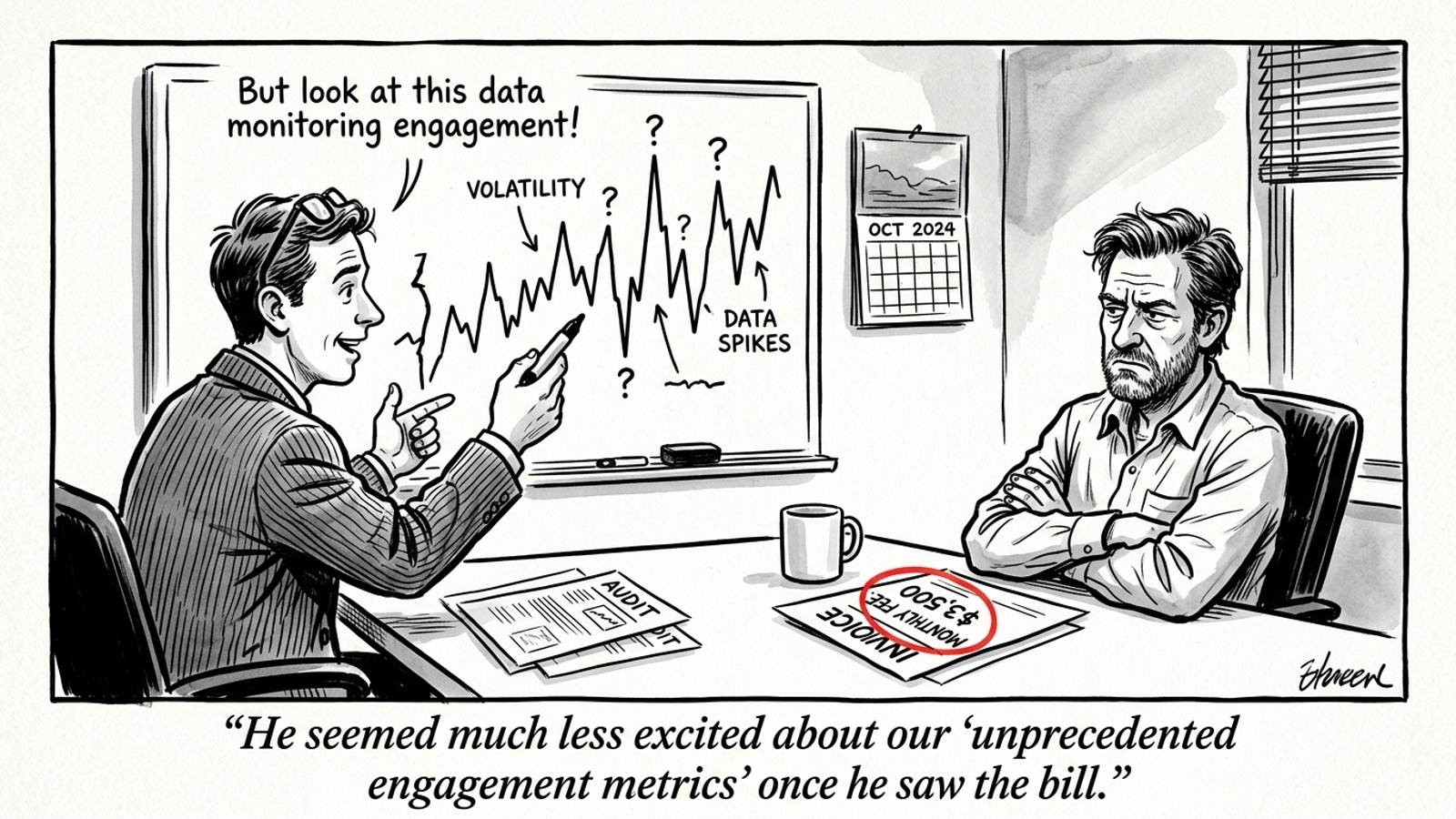
The problem gets sharper when monitoring is nearly the whole product. The SEO Agent’s breakdown describes standalone retainers built around a prompt-tracking dashboard, an audit checklist, and a monthly review call, while page creation, rewriting, and technical deployment sit with the client’s team or become add-ons. Clients can compare that arrangement with tracking tools priced at $49 to $99 a month. A $4,000 management invoice needs to buy more than an interpretation of software they could license themselves.
Bundling avoids promising a standalone outcome from a volatile measurement. The agency can judge the work alongside its broader organic program: pages improved, technical barriers removed, qualified traffic, pipeline, and sales. The client still deserves to know what shipped. They just do not need a second retainer whose most visible artifact is a chart.
The ten-domain margin math: software is not the service
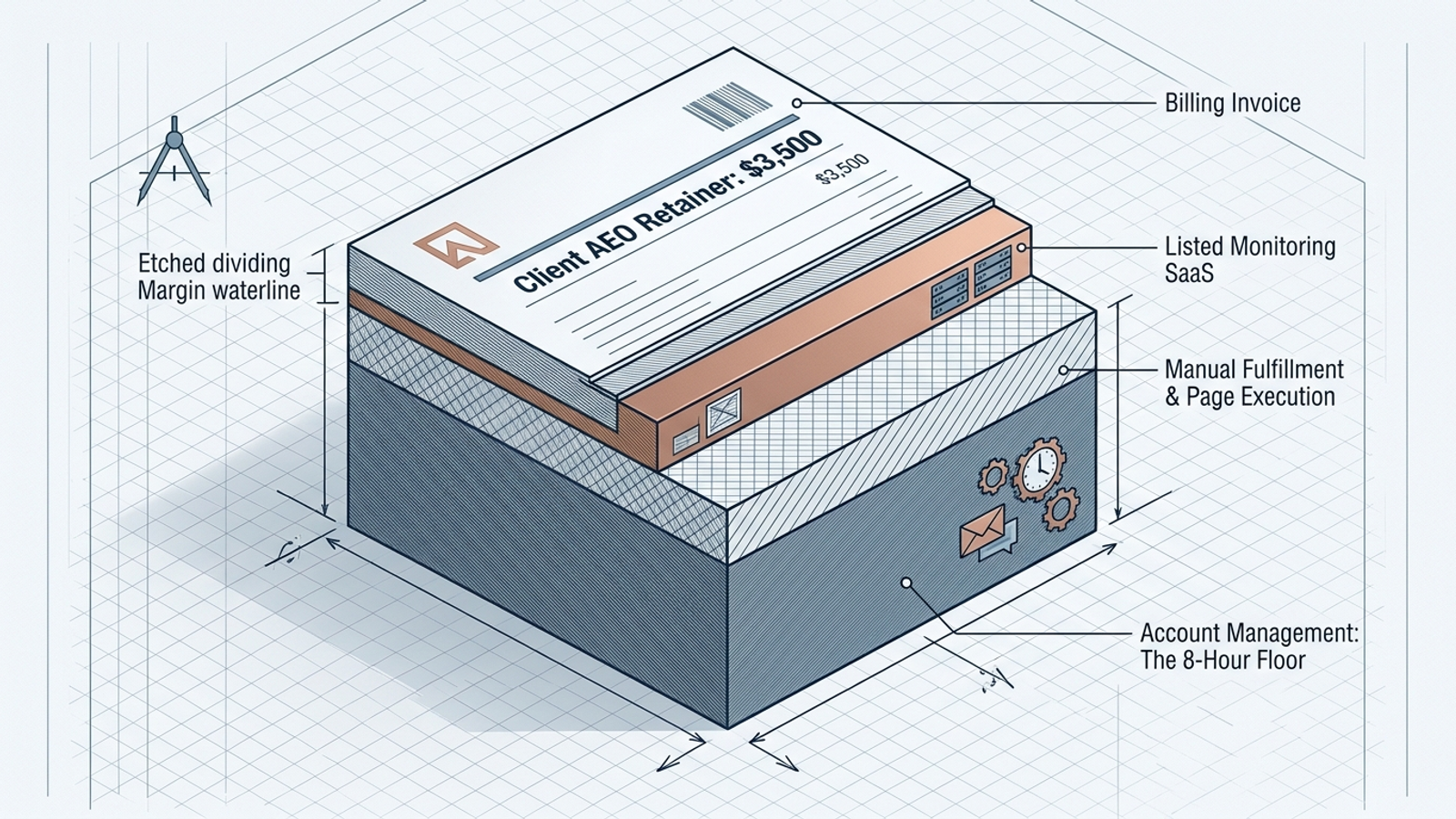
Here is the cost movement the sales deck tends to skip. For ten client domains, the draft operating estimate is $8,800 to $18,700 a month, depending on tooling, whether fulfillment is outsourced or staffed internally, and how much account management the service consumes. Treat that as a planning range, not a sum of every row below: the wholesale partner and internal specialist are alternative ways to deliver work. One-off onboarding sits outside the monthly range.
For a fuller roster model, see our line-by-line breakdown of a ten-client AEO retainer. These are the inputs that matter here:
| Cost | Ten-client figure | Timing | Where the figure comes from |
|---|---|---|---|
| Listed monitoring tools | $490–$990 | Recurring | Platform fees such as Ayzeo at $492/month or Semrush AI add-ons at $99/domain |
| Listed wholesale fulfillment | $4,290–$7,800 | Recurring, if outsourced | Done-for-you packages priced from $429/client via 51Blocks to $780/client via GEO.solutions |
| Internal specialist | About $10,200 | Recurring, if staffed internally | A median $96,400 salary plus 27% for payroll taxes and benefits, using First Page Sage benchmarks |
| Hidden account-management time | $3,600–$6,000 | Recurring | Three to five hours per client per month discussing volatile prompt tracking at an assumed $120/hour agency cost |
| Onboarding and setup | $1,800–$4,300 | One-off | Initial prompt mapping and schema audits, from $1,800 wholesale to a $4,300 agency average |
Now compare the packaging choices without pretending that total SEO revenue is all new AEO revenue:
- Separate line: $3,500 per client per month. Across ten clients, you invoice $35,000. If you count only a $492 monitoring platform, the apparent margin is $34,508. But that buys tracking, not execution. In one in-house delivery scenario, the platform, $10,200 specialist, and $4,800 of account-manager time total $15,492 a month before setup and other overhead. Outsourced fulfillment changes the cost structure, but it does not make client communication disappear.
- Bundled scope: $5,500 total SEO retainer per client per month. Across ten clients, you invoice $55,000 for SEO and AEO together. That is not $55,000 of incremental AEO revenue. The question is whether the existing team and fee can cover the additional work while keeping delivery anchored to business outcomes rather than a weekly prompt percentage. If the team cannot ship it, the bundle is not a bargain. It is an unfunded promise.
The hidden time matters even when the tool bill looks trivial. Agency consultant Katarina Dahlin calls attention to the eight-hour floor: the minimum time needed to service, orient, and communicate with an active retainer client. Add three to five hours per client explaining a noisy new report, and the supposedly effortless markup starts paying for meetings. I have seen enough “light-touch” services become calendar fixtures to take that line seriously.
The cost lesson has two ends:
- Cheapest mistake: Buy a $29 to $49 prompt tracker, attach a “monitoring fee” to the invoice, and give clients little reason to keep paying it after they inspect their software spend.
- Most expensive mistake: Sell a separate $5,000 monthly line with manual fulfillment, hire a $122,000 specialist to write FAQs by hand, and lose three clients in ninety days because the promised code changes and content never shipped.
What each side misses
Now the rebuttals. The unbundlers are right that a new buyer and a new budget can fund useful work. They are wrong when they confuse a clean line on the invoice with a defensible service. A prompt-tracking seat, screenshots, and a monthly explanation of fluctuations do not become execution because someone calls the meeting “strategy.” It is the percentage-of-spend trap from paid search wearing a new label: bill against a visible number, perform routine observation, and hope nobody asks what changed. I made the same point in my note to the agency owner adding AI SEO to every retainer. A meter is not a delivery engine.
The bundlers are right that much of the technical and editorial work belongs in good SEO. They are wrong if “it is already included” means nobody owns it. An account team at capacity cannot simply absorb direct-answer page rewrites, entity-level schema work, and conversational citation monitoring across eight AI search surfaces every day. The neatest bundled pitch in the world is worthless if it produces no changes on the site. The client does not benefit from your principled packaging decision; the client benefits when the work gets done.
Verdict: a separate fee must buy shipped work
I would sell a separate AEO line to a mid-market or enterprise client with a distinct brand, digital PR, or AI budget only when the agency can show executed work: answer pages published, crawl blocks removed, structured data deployed, and citations secured. A visibility report can help direct that work. It cannot be the work. That is the single consideration that decides the invoice for me.
This is also why our agency partners use groas for agencies. Rather than asking account managers to interpret prompt meters or junior staff to write FAQs by hand, groas runs as an autonomous growth engine under the agency’s brand. Specialized models execute content, technical fixes, and citation building for a flat fee per domain; a named senior strategist oversees the account, and actions are logged with plain-language reasoning. When I assess AEO software for agencies, I care less about the chart than whether the platform can ship the work behind it.
For local businesses, small ecommerce brands, and founder-led clients, I would bundle AEO into SEO instead. They are buying qualified pipeline, not a debate about how search systems represent information. If the additional scope warrants it, raise the base fee by $500 to $1,000, make room for the work, and report what changed. Do not manufacture a second invoice just to name a second acronym.
My ruling is not “bundle by default” or “unbundle while the budgets last.” Charge separately when you can deliver a separately accountable stream of execution. Otherwise, put it inside SEO and stop selling observation as progress.